 plots
Memory is a bad record-keeper. By next February you will not remember which lettuce bolted first, which bed the flea beetles hit hardest, or what that row of carrots actually yielded. It will all blur into a general sense that the season "went okay." The growers who steadily improve are the ones who write it down while it is fresh, and then use it.
Your memory is worse than you think
We are not being hard on you here; we are being hard on all of us. Human memory smooths and edits. It remembers the standout success and the total disaster and quietly loses everything in between, which is most of the useful signal. Six months later you are left with a story, not a record, and the story is shaped by whatever happened last.
That matters because the next plan gets built on that story. You reach for the same variety because you think it did well, when in fact it bolted two weeks early. You skip a crop because you remember it as a flop, when the real problem was the bed and the timing. Without notes, you are planning against a rewritten past.
Write down the things you will actually compare
The notes worth keeping are the ones you will hold up against each other next year. In practice that is a short list:
Sow and transplant dates, so you can see what your real timing was, not what you intended.
Harvest weights or counts per bed, so you know what actually came off, not what the catalog promised.
Pest sightings, what you saw, where, and roughly how bad, so a pattern can show up over seasons.
What sold and what sat, because a heavy yield of something nobody bought is not a win.
None of this has to be elaborate. A weight, a date, a bed, a one-line note. The value is not in any single entry; it is in having enough of them, consistently, to compare.
The point is comparison
Here is what the record buys you. Next season's plan gets built on this season's real numbers instead of the seed catalog's promises. The catalog says a carrot is 65 days to maturity; your log says it took 78 in your ground, in your soil, at your sow date. That gap is not a mistake. It is your real days-to-maturity, and it is worth more to your planning than any printed figure.
Do this across a few crops and you start to see your farm as it actually is: which beds outperform, which crops reliably beat their catalog days and which lag, and when your recurring pests tend to show up. That last one is quietly powerful, because a pest window you can predict is a pest window you can get ahead of with cover or timing instead of chasing after the damage is done.
Walk the beds and log what you see
The habit underneath all of this is simple: walk the beds regularly and record what you find. Not a formal audit, just a steady pass with your eyes open and a way to capture what you notice before you have moved on to the next task and forgotten it.
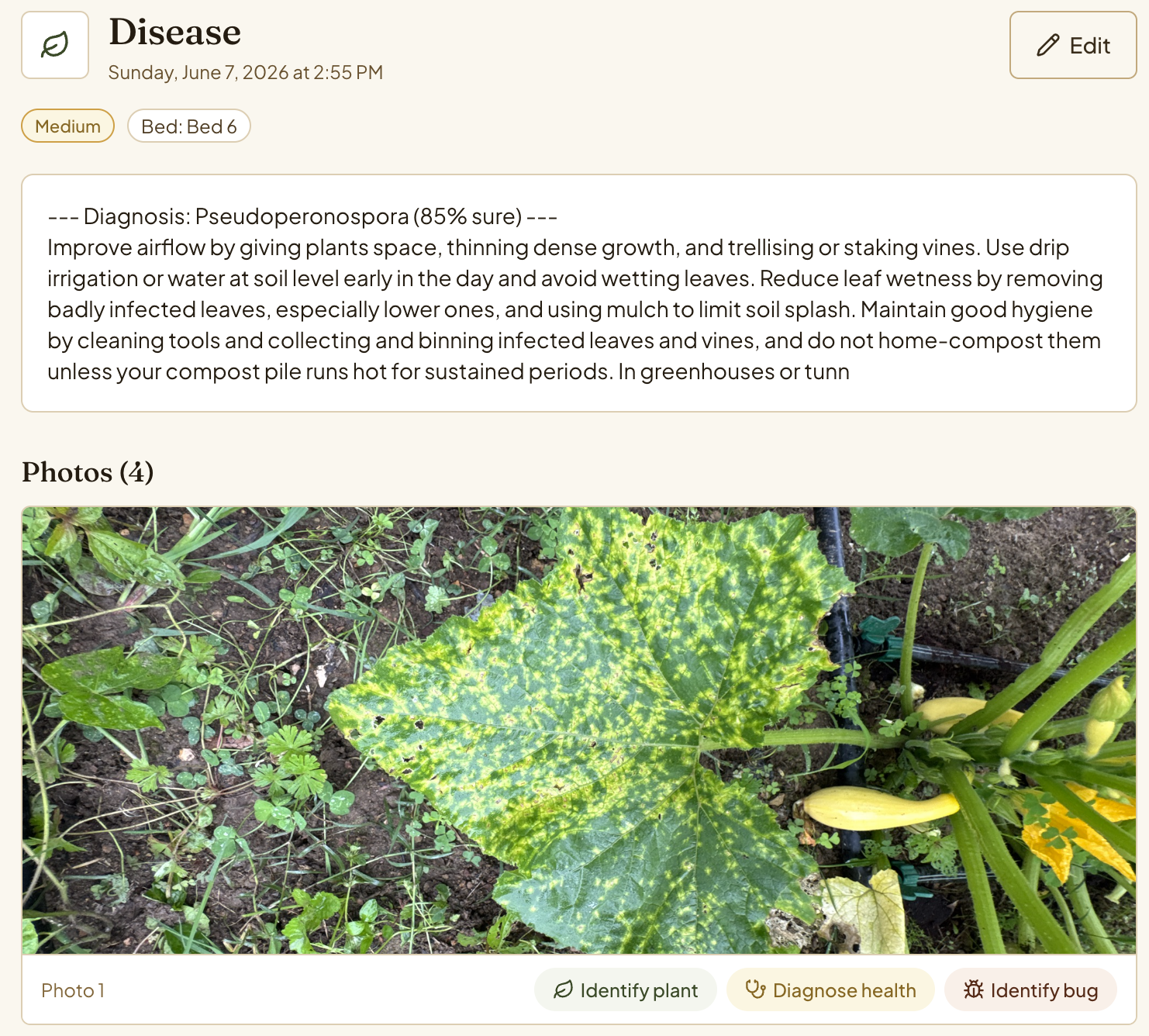
Two kinds of capture do most of the work. General observations are the catch-all: this bed looks nitrogen-hungry, the arugula is starting to bolt, the first flush of beans is ready. Pest scouts are the focused version: what pest, which bed, how much pressure. Keeping pest pressure noted per bed is what lets a heatmap emerge over time, so you can see that the same two beds take the worst flea beetle hits every year and plan the brassicas accordingly.
Pair that with recording actual harvest against what you planned, bed by bed, and you have closed the loop: you planned a number, you got a number, and now you can see the difference and learn from it.
Honest caveats
Records only help if you are honest about their limits.
Only collect what you will actually use. It is easy to design an elaborate tracking scheme in the quiet of winter and abandon it by June. If a field never informs a decision, stop collecting it. Data you never look at is just chores you resent.
A little consistent beats a lot sporadic. Three data points on every bed all season is worth more than a heroic, detailed week followed by two months of nothing. The comparison only works if the record is roughly complete, and complete-but-simple wins over rich-but-patchy every time.
And the payoff is delayed. One season of notes is a diary; it is genuinely useful but modest. The real value shows up in year two and year three, when you have something to compare against. That is a hard sell in a busy summer, which is exactly why keeping it light enough to sustain matters more than making it thorough.
How Plots.Farm helps
The reason field notes so often fail is friction: a notebook that lives in the wrong coat, a spreadsheet you never open, entries you mean to make and never do. Plots.Farm is built around lowering that friction and then paying it back. Observations and Pest scouts capture what you see while you are standing in the bed, harvest logging records what actually came off each bed, and the plan compares planned against actual so the gap is visible instead of forgotten.
Over a few seasons that turns scattered notes into something you can plan against. The per-bed pest heatmap makes your recurring pressure spots obvious, and your accumulated history, your real days-to-maturity, your best-performing beds, your recurring pest windows, becomes the ground your next plan stands on. Year two starts from evidence instead of memory. The tool cannot make you walk the beds, but when you do, it makes the walk count.
Walk the beds, write down what you see, and let next year's plan start from evidence.
Create your farm and start logging observations, pest scouts, and harvests this season.
Pass it to a grower who keeps meaning to start keeping records.