 plots
plots
For lettuce, planting closer pays off, right up until it doesn't. Here is where the line bends, and exactly how many rows to put on a 30″ bed.
Every grower has read the back of a seed packet. Lettuce, 8″ apart in the row, 12″ between rows. Most market gardeners quietly ignore it and plant tighter, and they are right to. That 12″ gap was drawn for a tractor wheel, not a lettuce; on a hand-worked bed you can take most of it back. But the idea that tighter is always better breaks down at a point you can actually measure, and that point depends entirely on what you are selling.
One crop, two rules
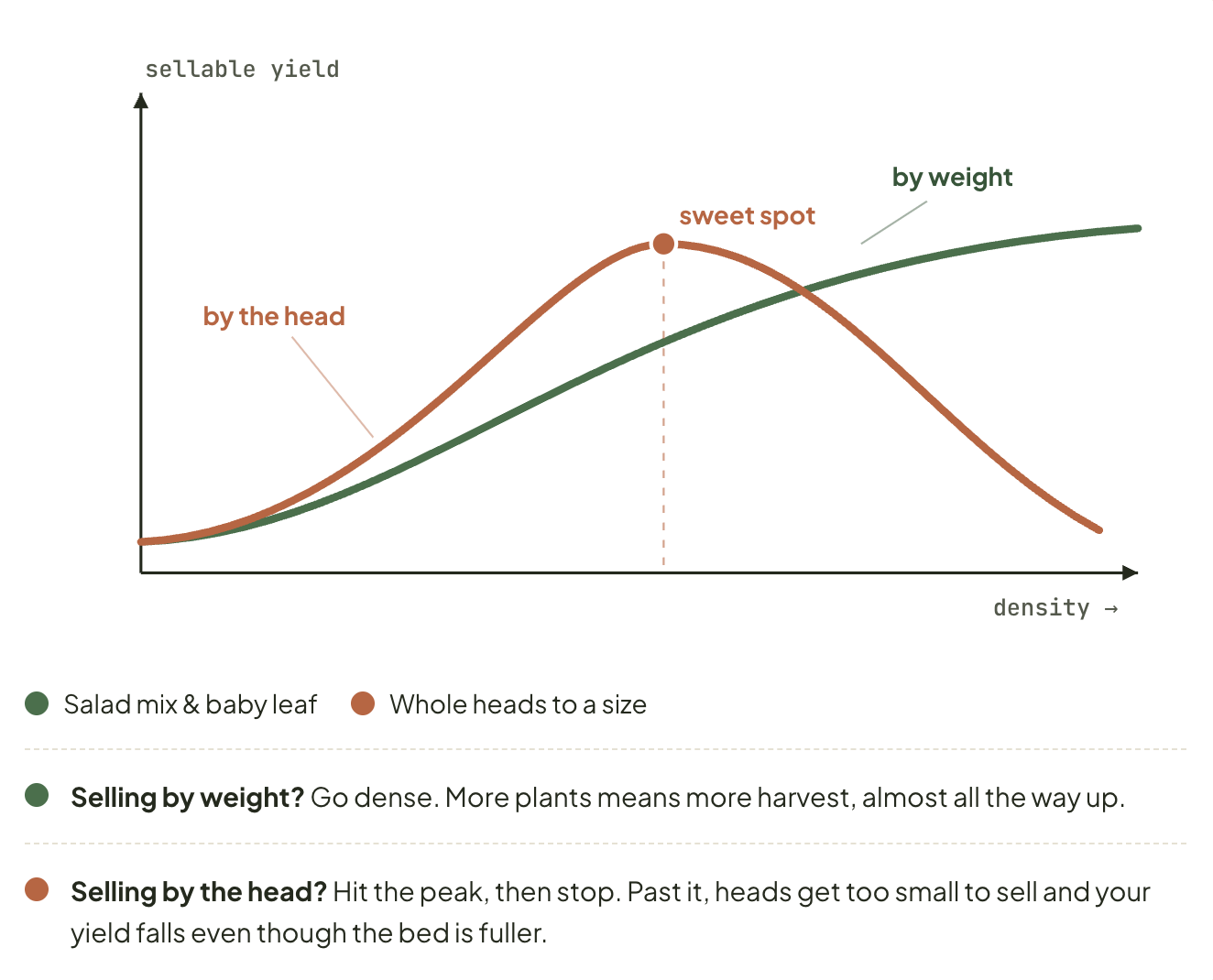
Pack a bed tighter and total leaf weight just keeps stacking up; that is exactly why salad mix is sown thick. A head is different. It has to reach a size someone will buy. Crowd too many in and each one stays small, so your plant count climbs while your saleable yield quietly falls back down. Same crop, two opposite curves.
Put it on a 30″ bed
Same bed, same lettuce, three layouts. The gain comes from fitting more rows across the bed, not from squeezing plants closer in the row. Packet style leaves nearly half the bed as walkway it does not need.
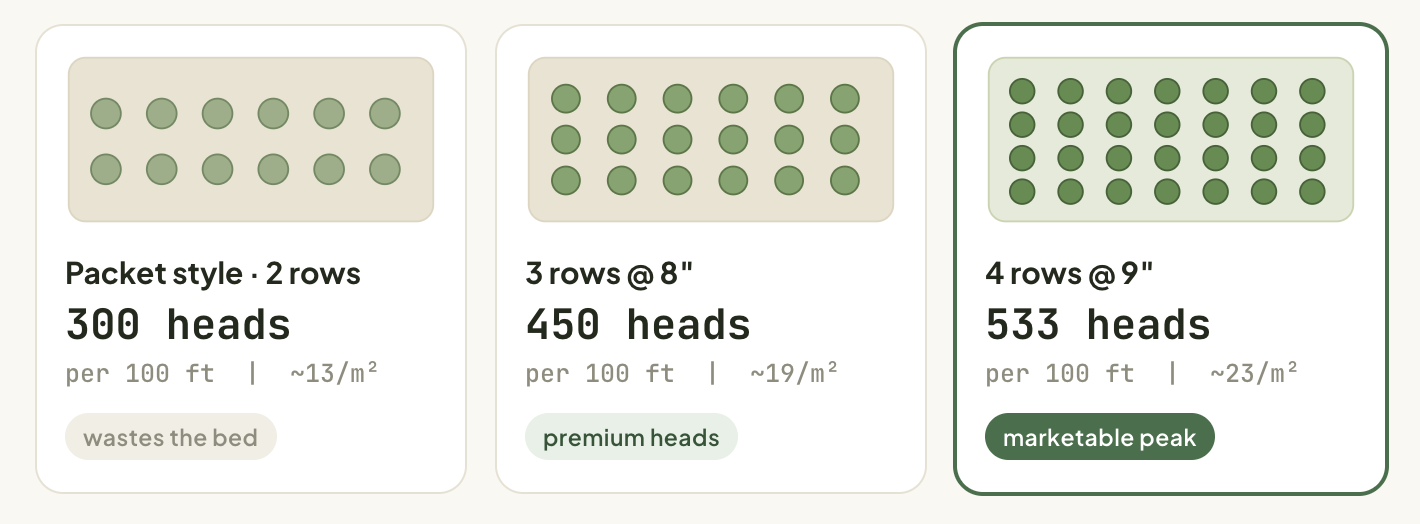
Three rows is the safe premium play: fewer, bigger heads. Four rows pushes you onto the peak of the head curve, the most saleable heads a bed will give before size starts to suffer. Go past four and you slide down the far side, back to a crowded bed full of heads too small to sell.
Find your own peak
The exact top of the curve moves with your variety, soil and season. So don't take my number on faith. Next planting, run one bed at 3 rows and one at 4, weigh the saleable heads from each, and let your scale tell you where your peak sits.
Want to stop running this math by hand?
That's exactly what we're building PlotsFarm for. You lay out your beds, pick a crop, and set your row count and spacing; PlotsFarm tells you how many plants the bed holds and what yield to expect, before you seed a single tray. Plant it, log what you actually harvested, and the numbers sharpen over time until the app knows your farm's real peak for each crop, not a seed-packet guess. Spacing, plant counts, and yield estimates, all in one place, so every bed is a little more dialed in than the last.
Built by a grower, for growers. Get early access at plots.farm
Curve shapes and yield figures from a field trial that caught both at once: Mengistu, Tabor, Dagne, Atinafu & Tewolde (2021), African Journal of Agricultural Research 17(4):549–556 (open access). The crisphead variety peaked then declined with density; the loose-leaf variety kept climbing. Model basis: Bleasdale & Nelder (1960), Nature 188:342; Holliday (1960).