 plots
plots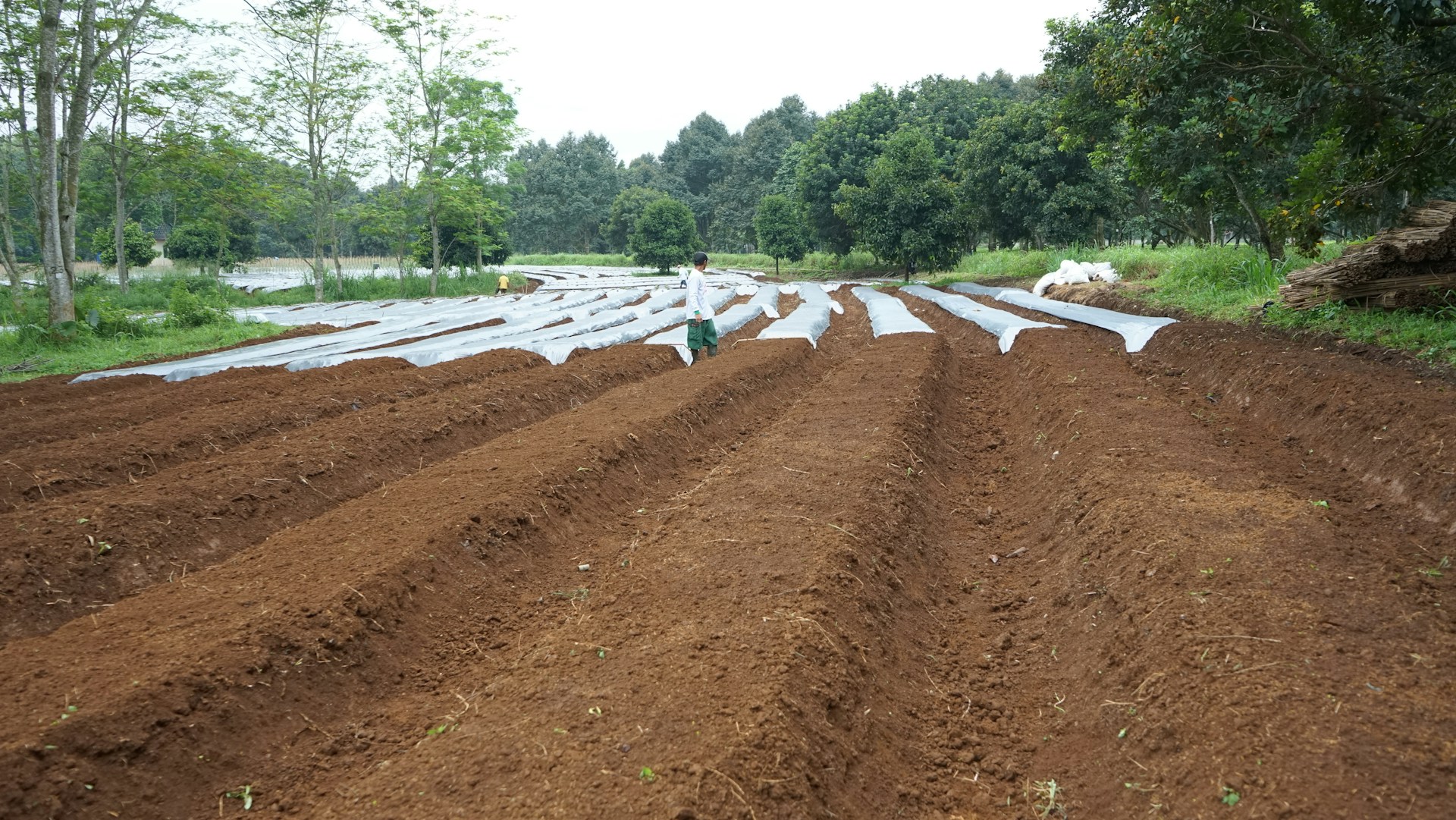
Walk your plot in the middle of the season and count the beds with nothing in them. Not the ones you are resting on purpose; the ones that are just between crops. Pulled last week, not replanted yet, waiting on a tray that is not ready or a decision you have not made.
Every one of those beds is still costing you. It is irrigated, or it was. It is weeded, or it will need to be. It holds a slot in your rotation and a line in your head. The only thing it is not doing is earning. An empty bed in July is not neutral; it is a bill you are paying with nothing coming back.
Here is what that bill actually looks like, and how to plan so you stop paying it.
What a bed earns when it is working
Start with the upside, because that is the number that makes the empty bed hurt.
Take a standard bed: call it 30 inches wide and 50 feet long, about 125 square feet. What it earns in a year depends almost entirely on what is in it and how many times that bed turns over before the season ends.
| Tier | Example crops | Turns per year | Ballpark gross per bed per year |
|---|---|---|---|
| High | Salad and baby greens (cut mesclun, arugula, spinach) | 6 to 10 | $3,000 to $5,000 |
| Medium | Radish | 5 to 8 | $1,000 to $1,500 |
| Medium | Garlic | 1 (holds the bed about 8 months) | $600 to $900 |
| Low | Carrots | 2 to 3 | $400 to $700 |
These are gross figures at direct-market prices, in a long season, grown by someone who knows the crop. Your numbers will move with your region, your market, and your skill. Treat them as the shape of the thing, not a promise.
Two things to read out of that table. First, the high earners are high mostly because they are fast. Cut greens do not pay more per pound than carrots because the leaf is precious; they pay more per bed per year because that bed turns six, eight, ten times while the carrot bed turns twice. Speed is the multiplier. Second, garlic is the honest outlier: a respectable number, earned by holding the bed nearly the whole year for a single harvest. It is not a bad crop, it just cannot stack turns, so it lives or dies on getting that one slot right.
(A note on microgreens, since people lump them in with greens: they are a bench-and-tray crop, not really a bed crop. Per square foot they out-earn anything on this list, but they live indoors on a different clock, so they are a different conversation.)
The number that should bother you
Now run it backward. A prime greens bed earning $4,000 across a roughly 30-week selling window is making about $130 a week while it is working. Call it $100 to $150 a week to stay conservative.
Leave that bed idle for the three weeks between pulling one crop and getting the next one established, and you gave up $300 to $450. Off one bed. Once. Do that four times across the season, which is easy to do without noticing, and that single bed quietly lost more than a thousand dollars of work it was sitting right there ready to do. Now multiply by the handful of beds doing the same thing on the same week.
The empty bed never sends you an invoice. That is exactly why it is expensive. A spray you can see on the receipt. Idle ground just disappears into "that is how the season went."
Why beds sit empty
It is almost never laziness. It is one of three things, and all three are planning problems, not effort problems.
The seedlings were not ready. The bed came open on a Tuesday and the next crop was not seeded in time to meet it, so the ground waits for the tray instead of the tray waiting for the ground.
There was no plan for what comes next. You knew the lettuce was coming out; you had not decided what went in. So it came out, and then you thought about it, and the thinking cost ten days.
You could not see the gap coming. The bed opening up in three weeks is invisible when your plan lives in your memory and a notebook. You react to the empty bed in front of you instead of planning into the one that is about to open.
The fix for all three is the same: stop planning one bed at a time, and start planning the whole season at once, so the next crop is decided and seeded before the current one is even pulled.
Planning the season, not the bed
This is the part we built the Plan view for, because it is genuinely hard to hold in your head.
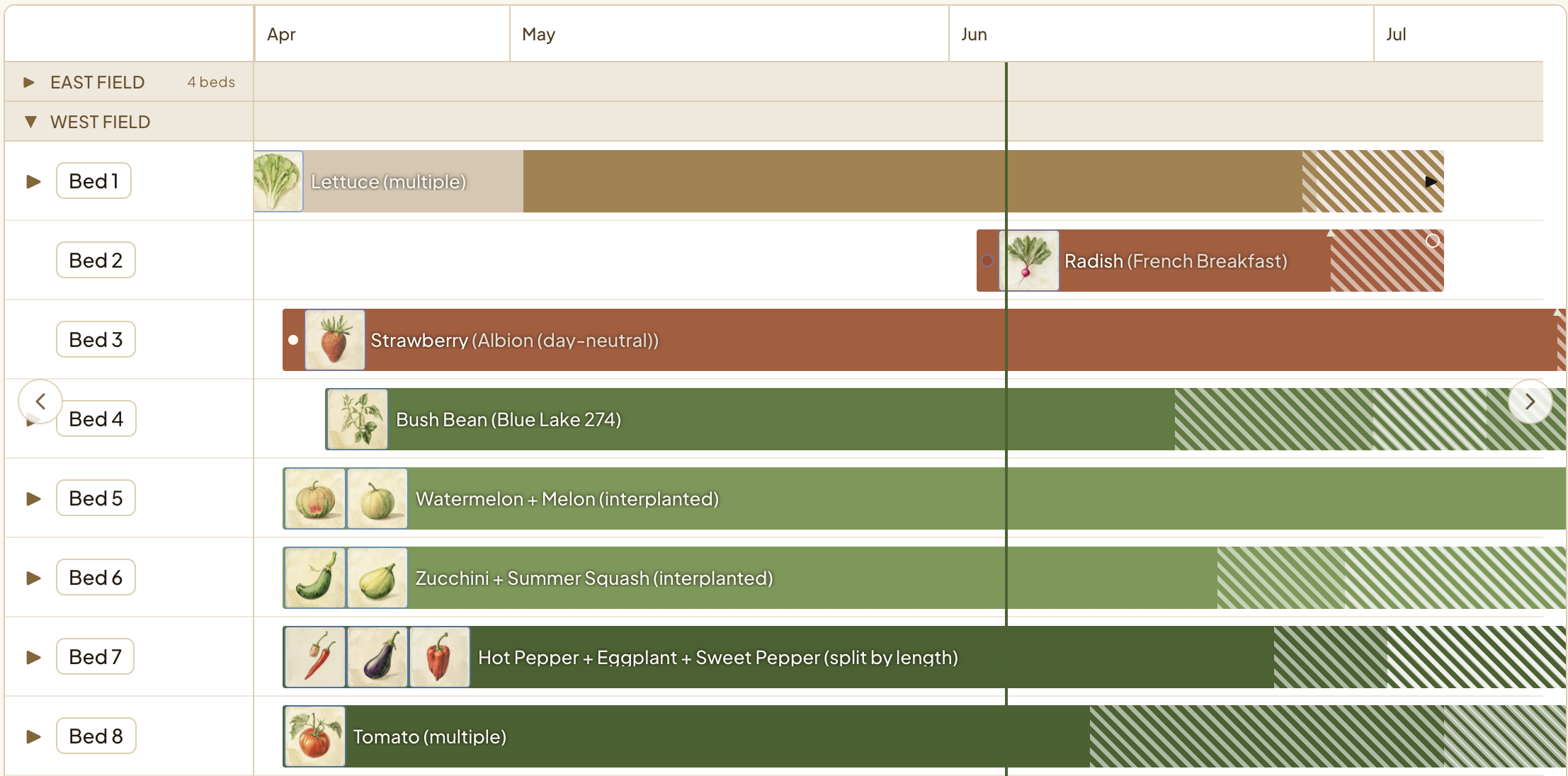
The Plan view is a Gantt chart of every bed across the whole year. Each planting is a bar; the bare stretches between bars are your empty time, drawn to scale. Switch it to "By bed" and you are looking straight at each bed's calendar: where it is full, and where it is about to sit idle. The empty weeks stop being a surprise you walk into and become a gap you can see coming and fill on purpose. Succession bands group the plantings that share a window, so a bed you turn eight times reads as a plan instead of a pile, and a today line and a year strip let you scan from now to frost in one look.
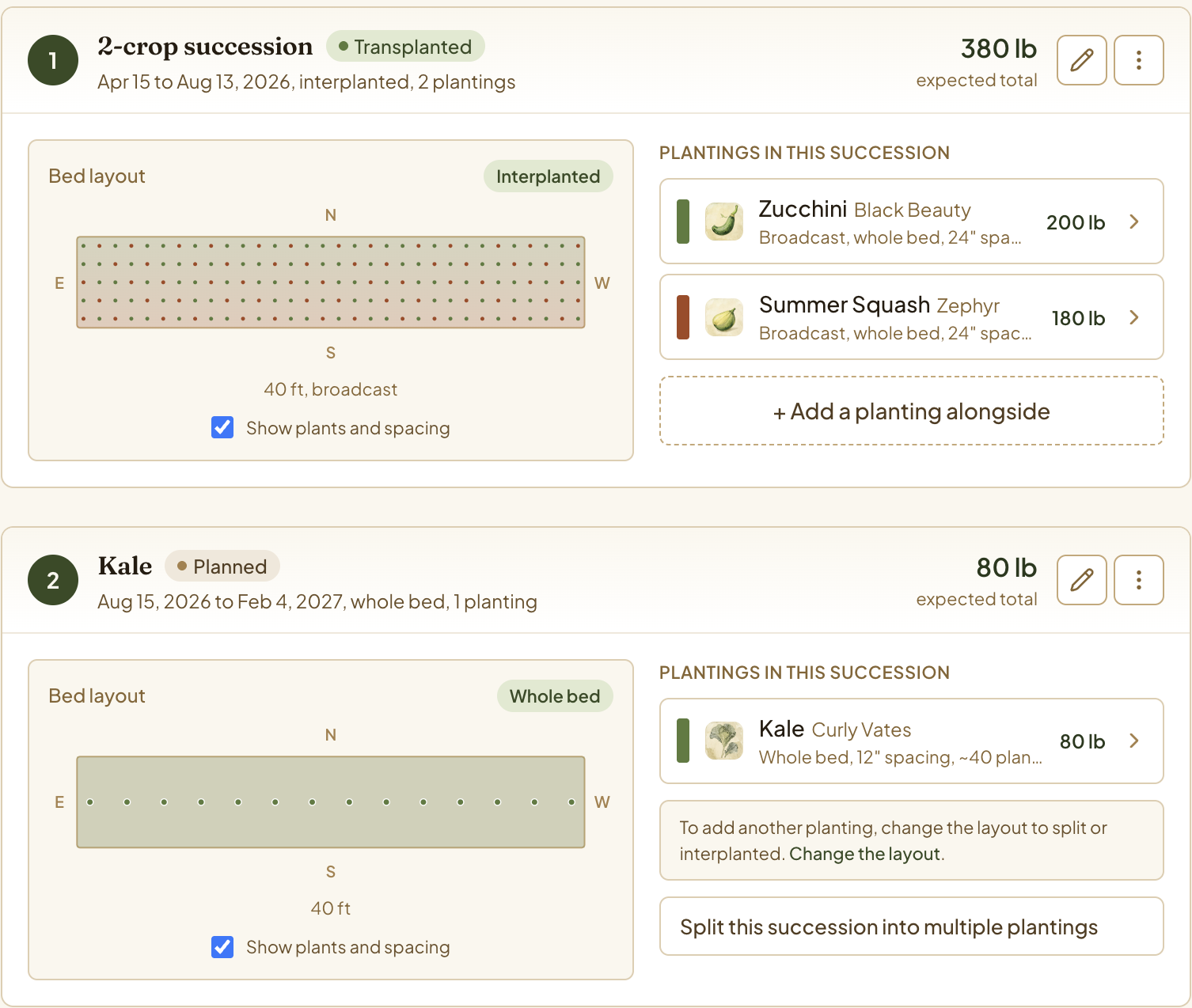
The point is not the chart. The point is that you seed the next crop while the current one is still in the ground, because you can see the handoff coming a month out instead of meeting it the morning the bed opens.
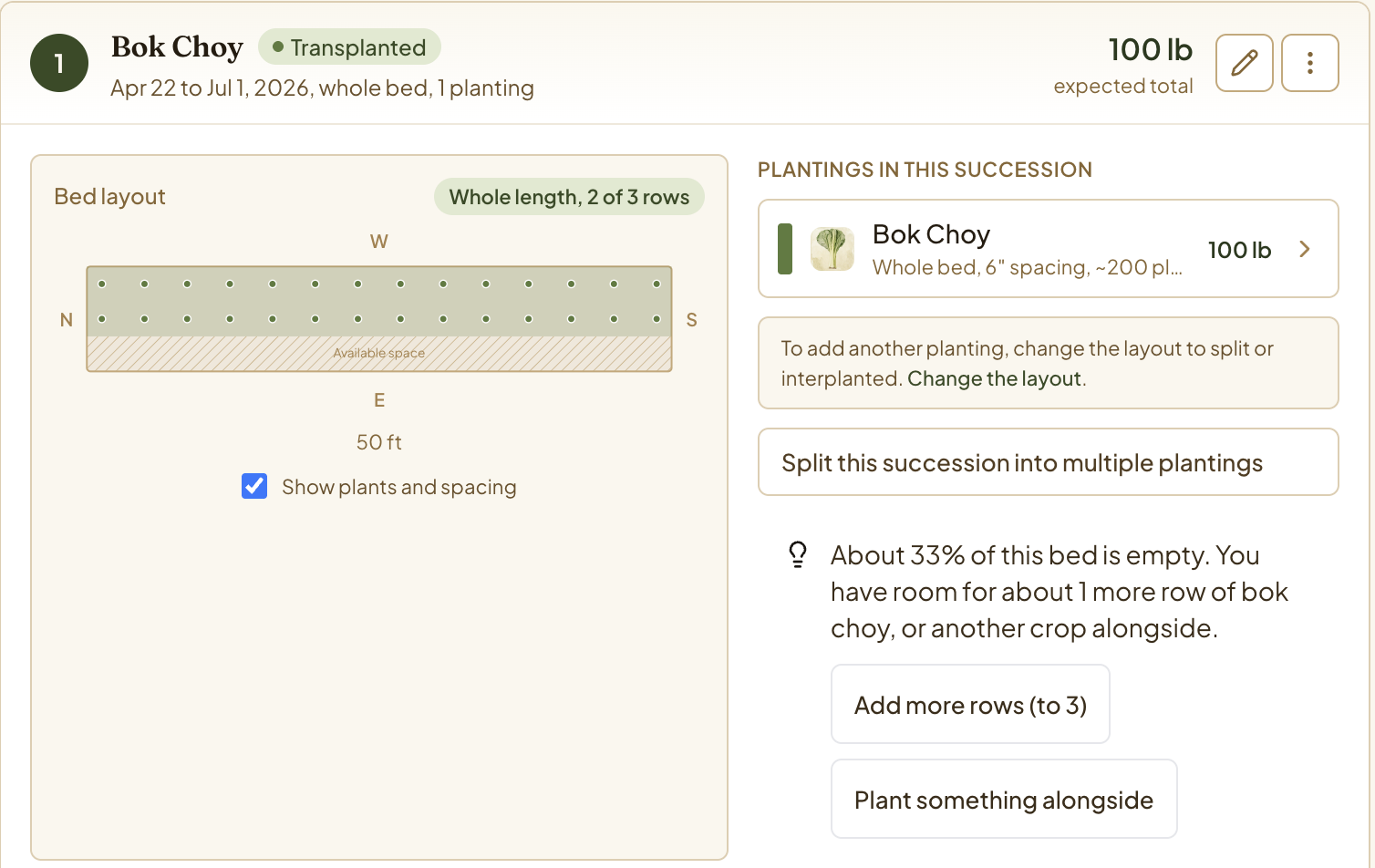
There is a second kind of empty worth naming. A bed can be full in time and still half empty in space: a "whole bed" spinach planting that only fills one of five rows is occupying ground it is not using. The Plan and bed views flag that quietly, with a faint hint and a space-used bar, when a planting is under about three quarters of the bed. No red, nothing to dismiss; just a nudge in case you meant to fill it and a reminder that you can tuck a fast crop alongside.
How to start
You do not need software to begin. Pick your three best beds, the ones in full sun with the good soil, and make one rule for them this season: those beds are never bare in season for more than a week. The next crop is seeded before the current one is pulled.
Then watch what it takes to hold that rule. The trays you have to start earlier. The decisions you have to make sooner. The gaps you did not know were there. That is the planning your whole plot actually needs; you are just learning it on three beds first.
An empty bed is the cheapest crop to fix and the easiest one to miss. Make it visible, plan into it, and it stops being the quiet leak in the season.
The fastest way to find your empty weeks is to see the whole year at once. Set up your farm on Plots.Farm, map your beds, and lay your plantings onto the Plan view. The Gantt puts your whole season on one screen, so every gap between crops shows up as a bare stretch you can fill before it costs you the $100 to $150 a week a working bed earns.
Create your farm and start turning empty weeks into harvests.
And if this was useful, pass it to a grower staring at three empty beds right now.