 plots
Ask a grower how the farm did this year and most can tell you the top-line number: total sales, maybe a rough sense of whether it was a good year or a tight one. Ask them which bed made money and which one quietly lost it all season, and the room goes quiet. That is not a knock. It is just a number almost nobody tracks, and it is the most useful one on the whole farm.
Your true margin per bed is what a single bed earned after what it cost to grow. Not revenue. Not a gut feeling. The actual dollars left over. Once you have it, planning stops being guesswork.
Why revenue lies to you
A bed of salad mix and a bed of winter squash can bring in the same $400, and look identical on a sales report. They are not the same bed.
The salad turned four times, got seeded and weeded and washed and bagged every round, and ate your labor all season. The squash sat there, got harvested once, and cured in the barn. Same revenue, wildly different cost, wildly different margin. The sales number cannot see any of that. It tells you what came in and nothing about what it took to get there, which is exactly the half that decides whether you are actually making money.
This is how farms end up busy and broke. The beds that feel productive, the ones you are always fussing over, are often the ones eating the profit the quiet beds made.
The three things you actually need
You do not need accounting software or a degree to get this. You need three numbers per bed.
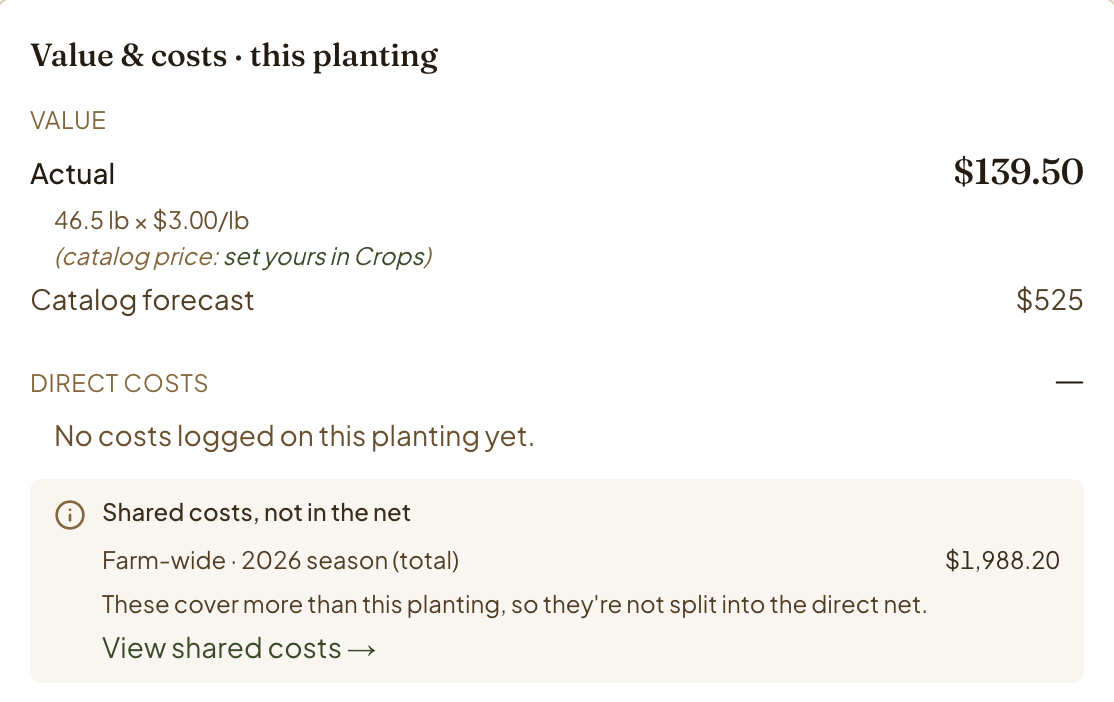
Revenue is the easy one: what that bed's crop sold for. Direct costs are next: seed, transplants, amendments, any inputs that went specifically onto that bed. The one people skip is labor, and it is usually the biggest cost on a small farm. Rough hours are fine. An hour seeding, three hours of weeding across the season, two hours harvesting and washing, times what you pay yourself or your crew.
Revenue, minus direct costs, minus labor. That is your margin. Do it for a handful of beds and a pattern jumps out fast: some crops are paying you a decent wage per hour and some are paying you three dollars.
What the number changes
Here is where it gets fun, because the answer almost always surprises people.
Maybe that high-value salad mix is actually your worst earner per hour once you count the washing. Maybe the "boring" storage crops are carrying the farm. Maybe one variety of tomato out-earns another by double for reasons that have nothing to do with yield. You cannot see any of this from the sales total, and you cannot fix what you cannot see.
I will say it plainly: a grower who knows their margin per bed will out-earn a better grower who does not, on the same land. Not because they work harder. Because they stop pouring hours into beds that pay poorly and put that time where it earns. Drop your three worst crops, expand your three best, and you can raise farm income without adding an inch of ground or an hour of work. That is the rare free lunch in farming.
The honest catch
Tracking this is a habit, and habits are hard in July when you are drowning. The number is only as good as the labor you actually write down, and labor is the thing everyone forgets to log. A margin figure built on guessed hours is better than nothing but worse than real ones.
And do not get precise to the penny. You are not auditing, you are comparing. Close-enough numbers across all your beds beat perfect numbers on two of them. The goal is to rank, not to reconcile.
How Plots.Farm helps
The reason most growers cannot answer this is that the pieces live in different places: sales in one notebook, seed orders in another, and labor nowhere at all. Plots.Farm keeps them against the bed they belong to. You plan the planting, log the harvest and what it sold for, and the crop carries a value pulled from your own market prices, so each bed builds a real record instead of a vague memory.
Because the harvest and the sale are tracked per planting, you can finally compare beds on the same footing and see which crops are actually worth their space. Pair that with the observations you log through the season, the weeding that dragged, the crop that failed twice, and next year's plan is built on what paid, not on what the catalog promised.
Pick five beds and run the three numbers this week, before the season blurs. The one that surprises you is the one worth knowing.
Create your farm and start tracking what each bed is really worth.
Pass it to a grower who had a busy year and still cannot say where the money went.