 plots
PlotsFarm for orchards and berry patches
Perennial rows
Forty blueberry bushes planted in 2021, a row of figs, two rows of blackberries on a trellis, and a June that arrives all at once. A perennial row does not run on a one-season clock, and the picking weeks are the whole year's revenue. PlotsFarm tracks a perennial planting for years instead of one season, counts the harvest by row, pre-sells the flats, and books the costs against the row, on one login with the vegetable beds.
What it fixes for orchards and berry patches
The problem
Forty blueberry bushes planted in 2021 are not a planting that starts in March and ends in October. Every annual planner asks you to re-enter them each spring or leaves them blocking a bed all winter.
What PlotsFarm does
Rows that keep their years
Fruit trees and berries have their own orchards pages. A perennial planting carries a life stage you set and a season phase PlotsFarm works out each day from your frost dates, so a row resting in winter is resting, not gone. Harvest totals span years per row, and adding the same variety on the next row is one duplicate action.
Blueberry (Tifblue) · Row 3 · planted 2021 · green fruit · 18 bushes
The problem
June arrives all at once. The flats are picked Thursday and have to be gone by Saturday, and the people who wanted them find out too late or show up when the cooler is empty.
What PlotsFarm does
Flats sold before you pick
Put the flat on your public farm page with a Thursday cutoff and a Saturday pickup, and bind it to the week's lot so the page stops selling when the cooler is spoken for. Buyers pay by card without an account. Orders arrive as a push while you are on the ladder, and the pick list says how many flats to pack per pickup.
Blueberry flat · 26 pre-orders · Sat pickup · 4 walk-up recorded
The problem
Mulch, netting, and a Saturday of pruning went into Row 3 this year, and the only number you have is what the whole farm spent. Whether the figs pay for their row is a guess.
What PlotsFarm does
Cost per row, net per crop
Book mulch, fertilizer, netting, and labor against a planting, a bed, a field, or the farm across six cost categories, with the season year kept separate from the day you paid. Water cost books itself from your irrigation zones. Log each picking against its row, and the crops report ranks every crop by net, so the figs and the blackberries are compared on the same page as the tomatoes.
Fig (Celeste) · Row 6 · 4 cost lines · season 2026
Crop planning
A section built for perennial rows
The crop library includes fruit trees and berries alongside vegetables and cut flowers. A perennial planting is planted once and tracked for years: a life stage you set, a season phase worked out from the phenology catalog and your frost dates, a years row, and harvest totals that span years, so a blueberry row is not forced into a single-season bar. End a planting when a bush is pulled, or replant the row.
More on crop planning →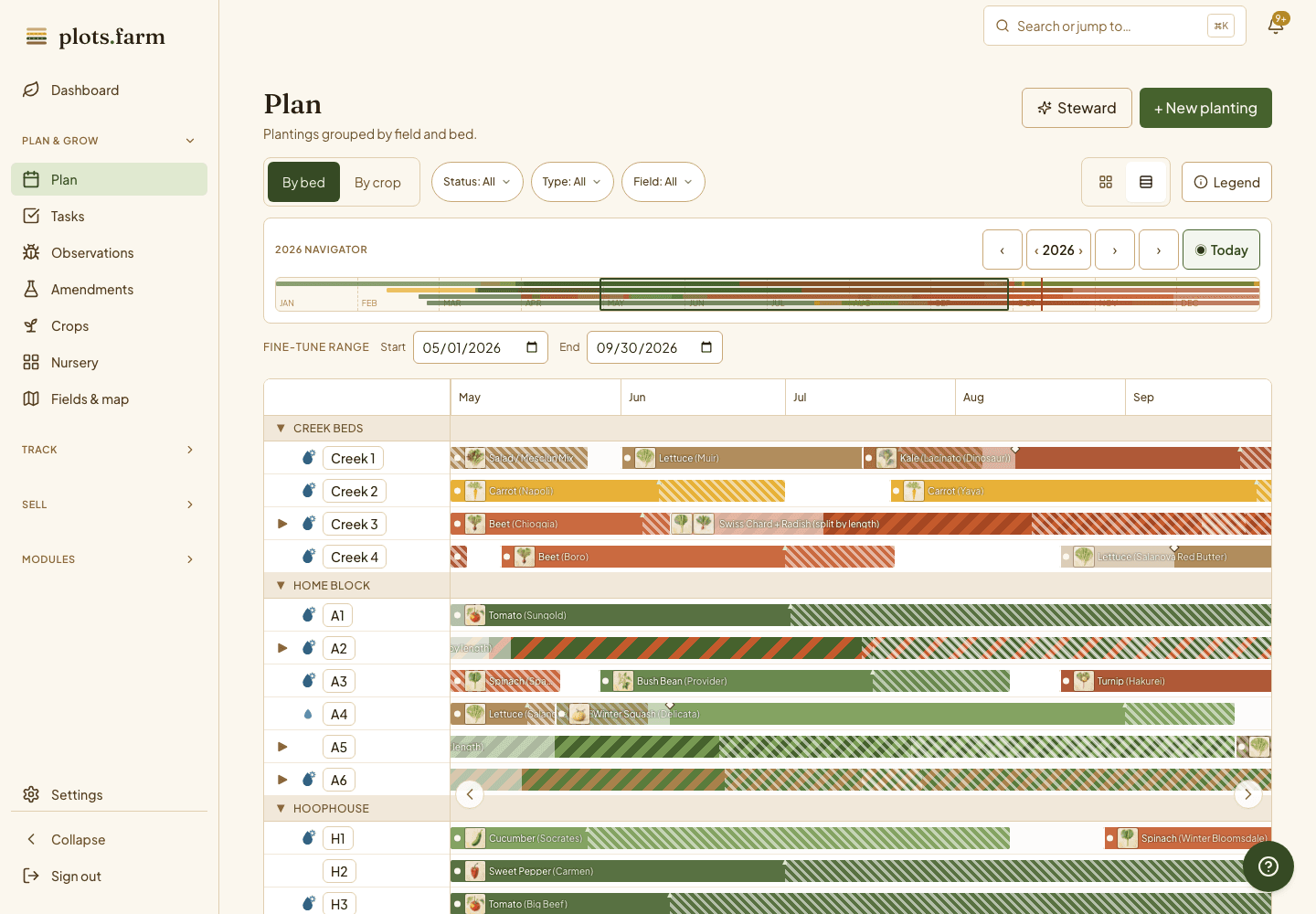
Harvests and inventory
Pickings counted by row
Log a picking against its row one at a time or in bulk at the end of a crew morning. Each harvest becomes a lot with on hand, committed, and available columns and a shelf life that flags flats within three days of turning. Multi-year totals per row show which planting earns its space. A count typed wrong in June is fixed in July without losing history.
More on harvests and inventory →Online store and pre-orders
Pre-sell the flats before you pick
Your public farm page lists flats, pints, and preserves beside any share you run. A weekly order window lets you pick to orders, and lot-bound products keep the page honest about what is in the cooler. Buyers pay by card with no account. Orders arrive as a push while you are on the ladder, and the pick list builds itself per pickup.
More on online store and pre-orders →Costs and performance
Cost per row, not per season
Book mulch, fertilizer, netting, and labor against a planting, a bed, a field, or the farm across six cost categories, with the season year kept separate from the day you paid. Water cost books itself from your irrigation zones. The crops report ranks each crop by net, so the figs and the blackberries get compared on the same page as the tomatoes.
More on costs and performance →Pricing
Start on the free tier
Free is a plan, not a trial. Plan the season, work the task list, log harvests, run a CSA and an online store, and take payments, with no subscription and no card. Selling carries a per-transaction fee; the numbers are on the pricing page.